Since I'm using the 817 mainly in /P, the original mike supplied with the radio is very stressed for the job. I've found an alternative one wich seems very useful for me: Vertex MH-67A8J. This mike is pin-compatible with MH-31 and is factory-supplied with Yaesu Ft-450 and also with some Yaesu/Vertex Land Mobile Radios (like VX-2100).
Is very big (almost twice that MH-31) and looks very rugged.
I've got one for few euros for an Italian ham and I've done a few on-air test on last sunday, and other hams reports that sounds identcal to MH-31.
lunedì 12 novembre 2012
venerdì 24 agosto 2012
TS-50 to LDG Z-100 plus connecting cable
Using the infos gathered on the net and showed in my previous post, I'm ready to build a quick-and-dirty cable.
Purpose of the cable:
- DC supply the LDG tuner from TS-50 ACC connector
- enabling the "AT TUNE" button on TS-50
The sketch below shows the circuit (press to enlarge). The ACC conncetor is shown radio side.
The TT and TS lines are connected together via a 3.3 Kohm resistor. The + and - lines are connected to LDG power conenctor via a 1 A fuse on the NEGATIVE path of supply lines.The ACC connector used is a PC surplus connector as shown elsewhere in my blog.
The final result is in the photo below:
Ok, seems like a sort of wire patchwork (green, white, black, red, yallow....) but IT WORKS!
Using the tuner with this cable is simple:
- Press TUNE button on LDG
- Press AT TUNE button on TS-50
- Wait for a match
- REMEMBER to shutdown the carrier pressing again AT TUNE on TS-50
Interfacing Kenwood rigs to LDG Tuners
I need to connect my LDG Z-100 plus tuner to my Kenwood TS-50, and googling on the net I've found some useful information in order to understand the Kenwood tuner interface. I'll show the much interesting things I've found, may be useful tu someone. (some of the documents linked are in Italian)
Technical Description of the Kenwood Tuner Interface:
http://www.ham-kits.com/KWTuner/KWT%20technical%20description.pdf
Other interesting things:
http://home.ix.netcom.com/~hmlong/
http://www.arimagenta.it/progetti/pdf_doc/ICOM%20TUNER%20+%20RADIO%20KENWOOD.pdf
http://www.kb2ljj.com/data/kenwood/ts-50.htm (scroll down)
giovedì 9 agosto 2012
Cheap ICOM tuner connector
Playing around with an LDG Z-100 Plus which I've bought for my Kenwood TS-50, I've seen the ICOM cable which is delivered in the box of the tuner.
If you look at ICOM tuner connector, seems really very similar to Personal Computer hard drive supply connector
The PC molex plug fits near perfectly on ICOM connector! Great, anotter connector for free!
If you look at ICOM tuner connector, seems really very similar to Personal Computer hard drive supply connector
The PC molex plug fits near perfectly on ICOM connector! Great, anotter connector for free!
Cheap Kenwood ACC connector
I need an ACC 6 pin connector for my Kenwood TS-50:
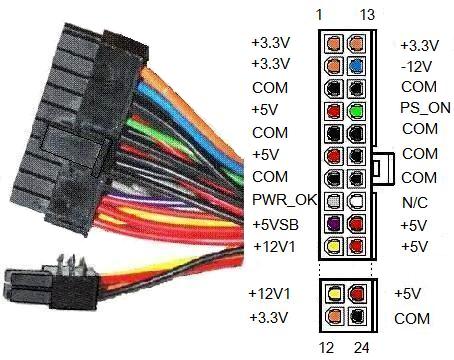
The connector seems very similar to ATX power supply connector (the power supply of the modern Personal Computers):
When I'm approaching to do some saw wors to cut six pins from the 20-pins connector, I've found that the LDG ATU cable for Kenwood rigs have only FOUR pins connected:
Looking at Kenwood docs, I've found that the two left pins (Transceiver side...) are the lower not connected and the upper connected at a signal ground. If LDG thinks that the signal ground is of little or no use, I'll follow the boss! I use the 4 pins in the detachable section of the connector (lower in ATX conn. image)
A little work with a screwdriver blade (light and softly!!!) in the middle of pins and...VOILA'! The connector is found for free!
martedì 31 luglio 2012
A great QSO in 15m with LU!
The past sunday I was amazed by a very fun QSO with Juan LU4VL in North Patagonia, Argentina. I was running about 2.5W with the 817 using a multiband up-and-outer antenna tuned with Elecraft T-1.
LU4VL report my signal 55, he was 59 on my side.
This morning I've received an e-QSL from a Brazilian SWL confirming the QSO. In his location I was 56.
LU4VL report my signal 55, he was 59 on my side.
This morning I've received an e-QSL from a Brazilian SWL confirming the QSO. In his location I was 56.
domenica 1 aprile 2012
Coaxial stub half-wave end-fed antenna for 10m band
I'm a true fan of end-fed antennas, and I've built one for 10 meters band.
The antenna itself is 5 meters long, and matching is obtained using lambda/4 coaxial stub. The matching method is the same used in J-Pole antennas: a lambda/4 * VF (velocity factor) transmission line shorted at the end.
I've used RG58 cable for matching line and 1mm PVC-covered copper wire.
The sketch below shows the building detalis:

The left side of coax is shorted; the right side is connected (only central conductor) to half wave wire (braid is not connected). At feeding point I've used a BNC T adapter to connect all together.
I use the antenna mounted vertical on a fishing pole and attached directly on the rear connector of my FT-817 (no cpunterpoise, no choke, no balun, no antenna tuner on 10m). SWR is acceptable (1.5 - 1.8 between 28.400 and 28.600).
Today in the morning I've got some nice QSOs. The most remarkable is Japan (Yeah!!!!)JA1NVF with 5W SSB! Not bad anyway, eh?
This antenna, tuned with my Elecraft T-1, is useful also on 12 and 15m. Build one for your preferred band, is an "instant" antenna, very cheap and simple to build. Of course, if you've a few meters of twinlead for build matching line, the performance may be better (modify lenghts....).
07-08-2014 UPDATE: Using this antenna I've many QSO with DX locations (Brazil, Argentina, Japan), and I won the 2013 CVA DX Award, see here.
The antenna itself is 5 meters long, and matching is obtained using lambda/4 coaxial stub. The matching method is the same used in J-Pole antennas: a lambda/4 * VF (velocity factor) transmission line shorted at the end.
I've used RG58 cable for matching line and 1mm PVC-covered copper wire.
The sketch below shows the building detalis:
The left side of coax is shorted; the right side is connected (only central conductor) to half wave wire (braid is not connected). At feeding point I've used a BNC T adapter to connect all together.
I use the antenna mounted vertical on a fishing pole and attached directly on the rear connector of my FT-817 (no cpunterpoise, no choke, no balun, no antenna tuner on 10m). SWR is acceptable (1.5 - 1.8 between 28.400 and 28.600).
Today in the morning I've got some nice QSOs. The most remarkable is Japan (Yeah!!!!)JA1NVF with 5W SSB! Not bad anyway, eh?
This antenna, tuned with my Elecraft T-1, is useful also on 12 and 15m. Build one for your preferred band, is an "instant" antenna, very cheap and simple to build. Of course, if you've a few meters of twinlead for build matching line, the performance may be better (modify lenghts....).
07-08-2014 UPDATE: Using this antenna I've many QSO with DX locations (Brazil, Argentina, Japan), and I won the 2013 CVA DX Award, see here.
Iscriviti a:
Post (Atom)